
Commercial Playground Equipment Manufacturers USA: 2026 Guide

Table of Contents
- What to Look For in Commercial Playground Equipment Manufacturers USA
- Commercial Playground Equipment Cost: What Drives Your Budget
- Playground Safety Standards ASTM CPSC: A Compliance Checklist
- ADA Compliant Playground Design: Ground-Level Play and Accessible Routes
- Materials, Durability, and Environmental Impact
- Installation, Project Management, and Grant Funding for Playgrounds
- Conclusion: Choosing the Right Manufacturing Partner
- Frequently Asked Questions
Last Updated: September 12, 2026
What to Look For in Commercial Playground Equipment Manufacturers USA
Choosing among commercial playground equipment manufacturers in the USA comes down to three things: certifications, warranty terms, and whether the provider handles installation or just ships boxes. A manufacturer that meets ASTM and CPSC standards and backs its work with a written warranty protects your budget and your liability exposure. This guide from Playground Equipment Pros draws on 40+ years of designing, sourcing, and installing play spaces for schools, parks, churches, and HOAs to show you exactly what separates a reliable partner from a costly mistake.
Most buyers start with the catalog. That is backwards. The provider's certifications, warranty language, and service model determine whether your project passes inspection and stays safe a decade from now. Below, we break down what to verify before you sign anything.
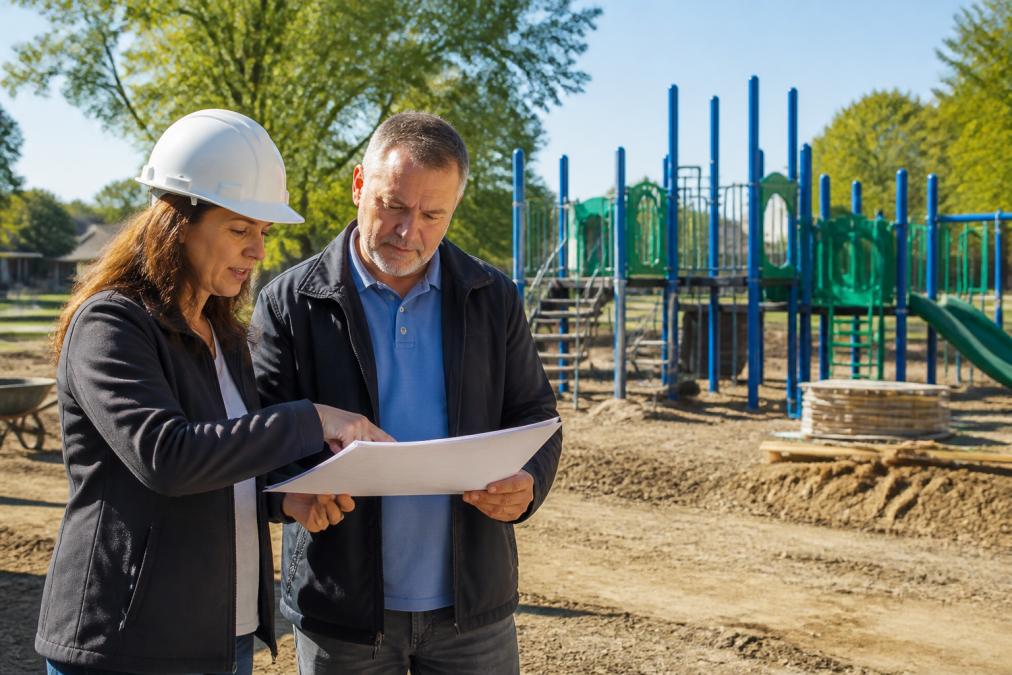
Certifications, Warranties, and Turnkey vs. Equipment-Only Providers
Certification means the equipment has been tested against recognized safety standards, not just marketed as "safe." Ask every provider for documentation showing compliance with ASTM standards and CPSC guidelines before you commit.
Warranty terms vary widely. A common mistake is comparing only the headline length and ignoring what is excluded. Look for coverage of structural components, hardware, and surfacing separately, because these fail at different rates.
Then decide on your service model:
- Equipment-only providers ship the structure and leave assembly, surfacing, and compliance verification to you.
- Turnkey providers manage design, sourcing, delivery, and professional installation as one contract.
For most schools, parks departments, and HOAs, turnkey removes the coordination risk that derails tight timelines. At Playground Equipment Pros, certified consultants handle the full scope, from concept through installation, so no gap opens between the drawing and the finished site.
Commercial Playground Equipment Cost: What Drives Your Budget
Commercial playground equipment cost depends on four variables: the number and type of play structures, safety surfacing, site preparation, and installation labor. There is no single price tag, and any provider who quotes one without a site review is guessing.
What actually moves the number:
- Play value per structure. Climbers, swing sets, and sensory play panels carry different costs and different lifespans. A single composite structure with multiple access points typically delivers more play value per dollar than several small standalone pieces, because you pay once for the safety envelope, footings, and surfacing footprint.
- Safety surfacing. Engineered wood fiber, poured-in-place rubber, and tile systems differ in upfront cost and long-term maintenance. Poured-in-place rubber carries the highest upfront cost but the longest service life; engineered wood fiber is the lowest upfront cost but requires annual replenishment and raking.
- Site conditions. Slope, drainage, and access for delivery equipment change the labor picture. A site that needs retaining walls, drainage correction, or a crane-assisted delivery can add significant labor before a single post is set.
- Compliance scope. ADA compliant playground design and accessible routes add design work that equipment-only sellers often leave out. Ramps, transfer platforms, and accessible surfacing are engineered components, not accessories.
Pricing depends on quantity, site conditions, and delivery, so treat any ballpark figure as a starting point for a conversation, not a budget line.
Total Cost of Ownership: The Numbers Buyers Miss
The purchase price is the smallest part of what you will spend. Total cost of ownership includes inspection, repair, surfacing replacement, and eventual component replacement over the life of the structure.
A useful way to frame it for a school board or parks commission is to split the budget into three buckets:
- Capital cost, equipment, surfacing, site work, and installation. This is the number on the quote.
- Recurring annual cost, inspections, minor repairs, surfacing top-off, and hardware replacement. Most practitioners find this runs a meaningful fraction of the original equipment cost each year, and it is the line item that gets cut first when budgets tighten.
- Lifecycle replacement cost, the eventual replacement of wear items: swing seats, bearings, slide beds, surfacing, and in some cases entire play components. These fail on predictable cycles, not randomly.
Many buyers find that a cheaper upfront quote costs more within a few years once maintenance and replacement parts are factored in. Ask each provider for a maintenance schedule and a parts availability commitment. If they cannot tell you how long replacement components will be stocked, that is your answer.
| Cost Category | Upfront | Ongoing | What to Ask |
|---|---|---|---|
| Equipment | High | Low | Parts availability window |
| Safety surfacing | Medium | High | Replacement cycle |
| Installation | Medium | None | Who certifies completion |
| Maintenance | Low | Medium | Recommended inspection schedule |
| ADA upgrades | Varies | Low | Included in design or add-on |
A practical TCO exercise: take the quoted equipment cost, add the surfacing cost, add installation, then multiply your expected annual inspection and maintenance estimate by the number of years you intend to keep the structure. Add one full surfacing replacement and one round of wear-item replacement. That total, not the quote, is what you are actually approving.
Playground Safety Standards ASTM CPSC: A Compliance Checklist
Playground safety standards ASTM CPSC define the design, installation, and inspection requirements your site must meet. Compliance is not a one-time event; it is an ongoing obligation that starts with the manufacturer and continues with your inspection routine.
The two references work together. ASTM F1487 is the voluntary consensus standard covering public playground equipment for children ages 2 through 12, it addresses structural integrity, fall height, entrapment, and the performance of the equipment itself (astm.org). The CPSC Public Playground Safety Handbook is a guidance document that translates similar principles into plain-language recommendations for layout, age zoning, and surfacing (cpsc.gov). Inspectors commonly reference both, and a manufacturer who can only speak to one is telling you something.
Use this checklist before installation and again at every annual review:
- Equipment documented as meeting ASTM F1487 for the relevant play structure type and age group
- CPSC guidelines followed for age-appropriate zoning and fall height limits
- Safety surfacing depth matched to the critical fall height of each structure, with the manufacturer's fall height rating on file
- Entrapment and entanglement hazards ruled out on all openings and moving parts
- Installation performed or supervised by qualified personnel
- Written inspection schedule established and logged
- Documentation retained for liability and grant reporting
The CPSC Public Playground Safety Handbook is the reference document most inspectors work from. Keep a copy on file and check your site against it annually.
What Inspectors Actually Look For
A compliance checklist is only useful if you know how it gets tested in the field. Inspectors and risk managers typically focus on a handful of failure points:
Talk with a Trusted Certifified Playground Consultant →
- Fall height vs. surfacing depth. Every structure has a rated fall height. The surfacing under it must be installed at a depth that matches that rating, and the depth must be maintained, engineered wood fiber compacts and displaces over time.
- Entrapment openings. The classic test is whether an opening can trap a child's head or torso. This is a design and inspection issue, and it is one of the most common findings on older structures.
- Hardware and fasteners. Loose bolts, missing caps, and protruding threads are the most frequent maintenance findings. A documented inspection log that shows these were checked and corrected is your best liability defense.
- Accessible routes. ADA compliance and ASTM/CPSC compliance are separate obligations that both apply. An accessible route that meets ADA does not automatically satisfy the safety standard, and vice versa.
Documenting Compliance for Grants and Liability
Grant programs and risk managers both want the same thing: evidence that you planned for safety and accessibility, not just that you bought equipment. Keep a compliance file that includes the manufacturer's ASTM F1487 documentation, the CPSC handbook reference, the surfacing fall height certification, the installation sign-off, and your inspection log. When a grant reviewer asks how you will maintain the site, that file is your answer.
ADA Compliant Playground Design: Ground-Level Play and Accessible Routes
ADA compliant playground design means every child can reach and use the play area, not just enter it. The requirement covers accessible routes to the play space, ground-level play components, and enough accessible elements to give real choice.
What this looks like in practice:
- A firm, stable accessible route from the parking area or building to the play zone
- Ground-level play activities such as sensory play panels and transfer systems
- Ramps or transfer platforms connecting elevated components
- Surfacing that stays firm and navigable for wheelchairs and mobility devices
What most guides miss is that ADA compliance is a design decision made at the concept stage, not an add-on after installation. Retrofitting accessible routes onto a finished site costs far more than planning them in. Ask any provider whether ADA compliance is standard on every project or an optional upgrade. The answer tells you how they work.
Materials, Durability, and Environmental Impact
Material choice determines how your playground looks and performs in year ten. Steel, aluminum, high-density polyethylene, and recycled composite each behave differently under heavy use and weather.
- Powder-coated steel handles structural loads and resists rust when the coating is intact.
- Recycled plastic lumber resists rot and splintering and supports environmental goals.
- HDPE panels hold color well and resist fading in strong sun.
- Hardware and fasteners are the most common failure point; specify stainless or coated options.
Durability is not only about the material. Structural integrity depends on the connection details and the quality of installation. A premium structure installed poorly will fail before a mid-range structure installed correctly.
Many organizations now weigh environmental impact and material sourcing in procurement. Ask providers whether recycled materials are used and where their components are sourced. This matters for grant applications that reward sustainable purchasing.
Installation, Project Management, and Grant Funding for Playgrounds
Installation and project management decide whether your timeline holds. A summer break window is tight but workable when one team owns design, sourcing, and installation from day one.
Project management covers site survey, permitting coordination, delivery scheduling, and inspection sign-off. When those tasks sit with three different vendors, delays compound. A turnkey provider keeps them under one schedule.
Grant funding for playgrounds is a real option for schools, parks, and community recreation departments. Most grant programs require documentation of compliance, accessibility, and long-term maintenance planning. Providers experienced with funded projects know what paperwork reviewers expect and can supply design renderings and compliance statements that strengthen an application. Check current program requirements directly, since eligibility and deadlines change.
For a small HOA working with a limited budget, the honest answer is that scope, not the provider, sets the floor. A phased plan that installs core structures first and adds components later often fits a tight number better than a single large purchase.
Conclusion: Choosing the Right Manufacturing Partner
The hardest part of a playground project is not picking equipment. It is finding a partner who will still answer the phone when something needs repair in year five. Certifications, warranty terms, ADA planning, and installation quality all trace back to that one decision.
Playground Equipment Pros has spent over 40 years helping schools, parks, churches, and HOAs build safe, compliant play spaces. Our certified consultants provide custom design with detailed 3D renderings, full-service installation, and equipment options for every budget, all compliant with CPSC, ASTM, and ADA standards. Talk with a trusted certified playground consultant and get a plan that holds up to inspection and to time.
Frequently Asked Questions
Who are the most reputable commercial playground equipment manufacturers in the USA?
Reputable manufacturers hold current ASTM and CPSC compliance documentation, carry multi-year warranties on structures, and can show a track record with schools, parks, and HOAs. Look for providers that offer turnkey services, from 3D design through installation, rather than equipment-only sales. Ask for references from similar projects and confirm the manufacturer's consultants are certified. A family-owned provider with decades of experience often gives you more direct accountability than a large catalog operation.
How much does it cost to build a commercial playground?
Commercial playground equipment cost depends on the number of play events, age group served, safety surfacing type, and site preparation needs. A small HOA play area with basic climbers and swings sits at the lower end, while a full school or park build with inclusive play components and poured-in-place surfacing runs significantly higher. Because pricing depends on quantity, site conditions, and delivery, request a custom quote rather than relying on generic online estimates.
What safety certifications should I look for in playground equipment?
Confirm the equipment meets ASTM F1487 for public play structures and CPSC Public Playground Safety Handbook guidelines for age-appropriate design, fall height, and surfacing. For accessible design, verify ADA compliance, including ground-level play components and accessible routes. Ask the manufacturer for written compliance documentation and confirm installation is performed by a certified team. Compliance is a shared responsibility, so keep your inspection records and maintenance logs current after installation.
How do I ensure my playground design meets ADA requirements?
ADA compliant playground design starts with ground-level play components, an accessible route connecting them, and clear use zones for mobility devices. Work with a consultant who builds accessibility into the design from the first sketch, not as an add-on. Ask for 3D renderings that show accessible routes and transfer stations, and confirm the equipment mix includes sensory play and inclusive elements. Review the final plan against the latest ADA Standards for Accessible Design before signing off.


